1. Lode Runner#
1.1 Introduction#
Lode Runner was a game originally written in 1982 by Douglas E. Smith (1960–2014) for the Apple II series of computers, and published by Broderbund.
You control the movement of your character, moving left and right along brick and bedrock platforms, climbing ladders, and "monkey-traversing" ropes strung across gaps. The object is to collect all the gold boxes while avoiding being touched by the guards. You can dig holes in brick parts of the floor which can allow you to reach otherwise unreachable caverns, and the holes can also trap the guards for a short while. Holes fill themselves in after a short time period, and if you're in a hole when that happens, you lose a life. However, if a guard is in the hole and the hole fills, the guard disappears and reappears somewhere along the top of the screen.
You get points for collecting boxes and forcing guards to respawn. Once you collect all the boxes, a ladder will appear leading out of the top of the screen. This gets you to the next level, and play continues.
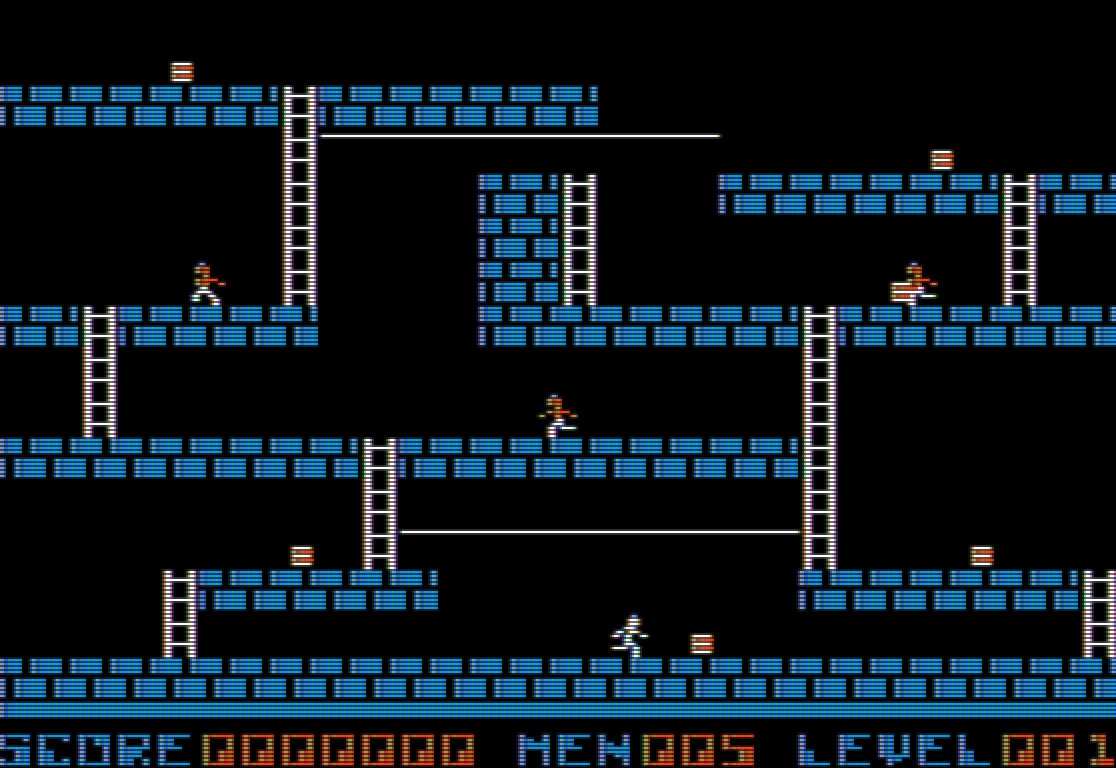
Lode Runner included 150 levels and also a level editor.
1.2 About this document#
This is a literate programming document. This means the explanatory text is interspersed with source code. The source code can be extracted from the document and compiled.
The goal is to provide all the source code necessary to reproduce a binary
identical to the one found on the Internet Archive's Lode_Runner_1983_Broderbund_cr_Reset_Vector.do
disk image.
The assembly code is assembled using dasm.
This document doesn't explain every last detail. It's assumed that the reader can find enough details on the 6502 processor and the Apple II series of computers to fill in the gaps.